Austin Short Sales: The 2022 Peak Haunts the Market
The Austin real estate market has a new data point that demands attention. As of Tuesday, March 31, 2026, there are 107 short sale active listings in the greater Austin area classified as short sales — and nearly one in three of those homes was built in 2022, the very year the Austin housing market reached its historic peak. That single statistic tells a story about what happened when buyers rushed into brand-new homes at the top of the market, and what those decisions look like today.
A short sale occurs when a homeowner owes more on their mortgage than the home is currently worth and the lender agrees to accept less than the full payoff amount. In a healthy, stable market, short sales are rare. Their presence in notable numbers is a signal that a segment of homeowners — particularly those who purchased at or near peak pricing — are now navigating financial stress. The Austin housing market saw extraordinary price acceleration between 2020 and mid-2022, and the year-built data from today's active short sale inventory reflects that history in striking detail.
The 2022 Concentration: A Market Peak on Record
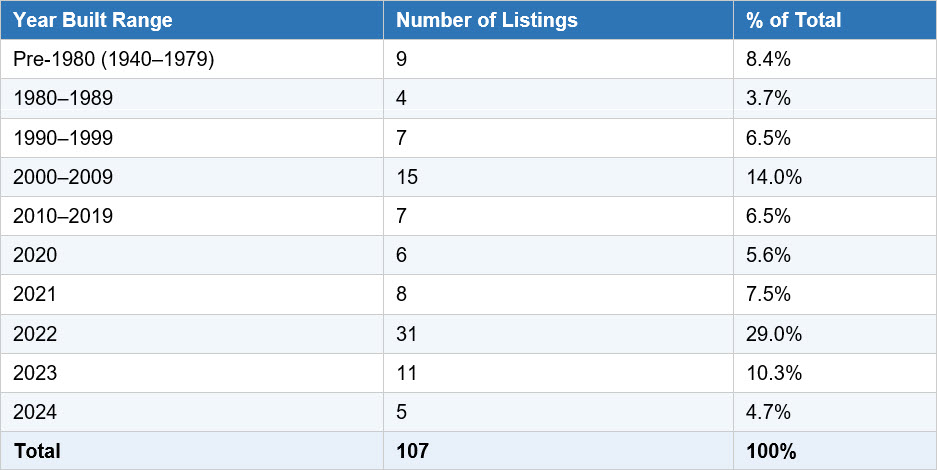
Of the 107 active short sale listings tracked on March 31, 2026, exactly 31 — or 29.0% — were built in 2022. No other single year comes close. The next largest cohorts are 2023 with 11 listings (10.3%) and 2021 with 8 listings (7.5%). Together, homes built between 2020 and 2024 account for 61 of the 107 active short sales, representing 57.0% of the entire short sale inventory. This concentration in post-2019 construction is not coincidental — it maps almost precisely onto the period when Austin home prices surged to levels that many buyers are now unable to sustain.
The 2022 dominance is particularly telling. That year marked the apex of Austin's pandemic-era price run, with median home values reaching heights that had little historical precedent in the market. Buyers who purchased new construction in 2022 — often paying premium prices for homes in fast-growing suburban corridors — are now among the most likely to find themselves underwater. The short sale process gives those homeowners a path forward, but it also puts downward pressure on comparable listings and signals unresolved distress in the newest segments of the austin housing market.
Looking at the broader year-built distribution, the data shows a clear two-part picture. Homes built before 2010 account for 35 of the 107 short sales (32.7%), spread across several decades from 1940 through 2009. These older homes reflect more traditional distress patterns — economic hardship, job loss, or extended financial strain that is not necessarily tied to market timing. The post-2019 concentration, by contrast, reflects a market-timing problem: buyers who entered at the wrong moment in the cycle.
Price Bands: The $300K–$400K Epicenter
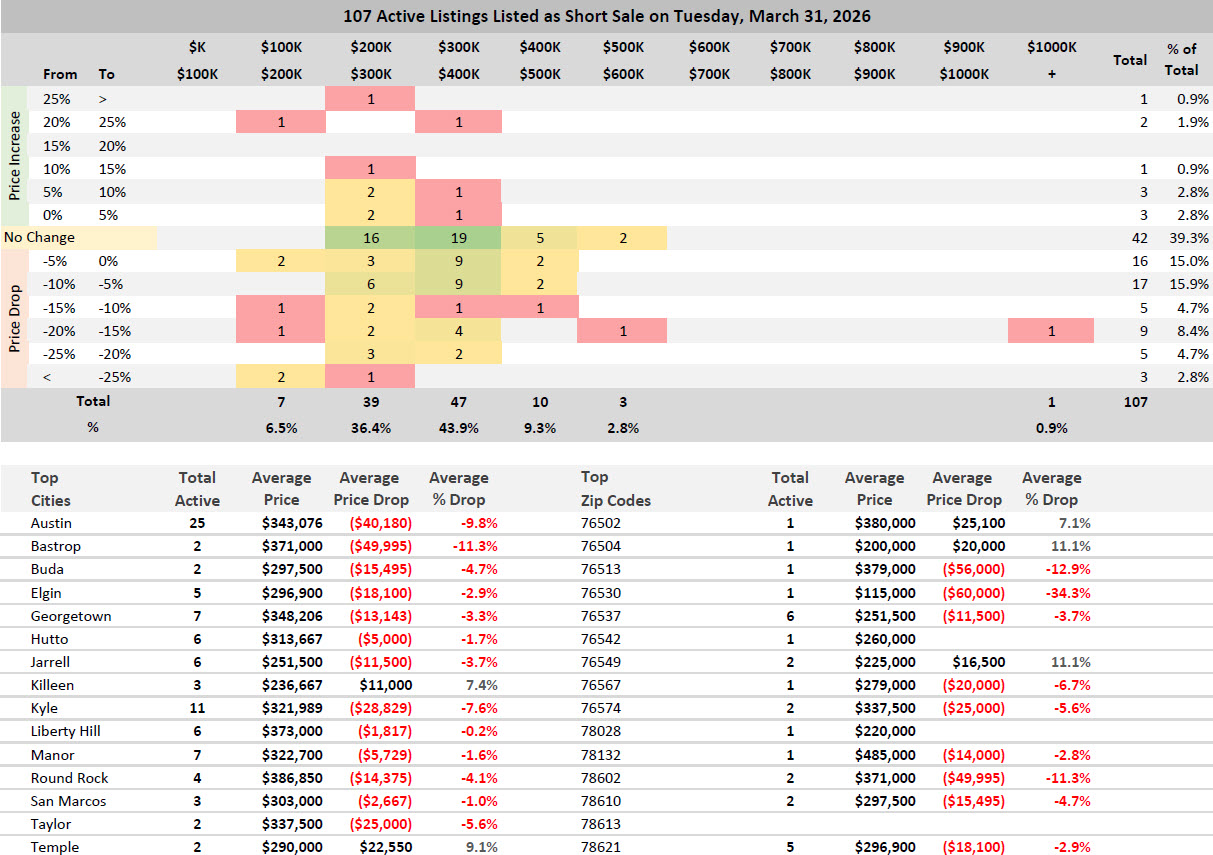
The price distribution of Austin's active short sale listings reinforces a clear picture of where distress is concentrated. The $300,000 to $400,000 price band holds the largest share with 47 listings, representing 43.9% of all active short sales. The $200,000 to $300,000 range is the second most active band with 39 listings (36.4%). Combined, these two price ranges account for 86 of the 107 listings — or 80.4% of total active short sale inventory — pointing to a distress problem that is squarely rooted in the mid-tier price segment of the Austin property market.
The upper price tiers are notably thin. Only 10 listings (9.3%) fall in the $400,000 to $500,000 range, 3 listings (2.8%) in the $500,000 to $600,000 range, and a single listing above $1,000,000. The $600,000 to $1,000,000 range has no active short sale listings at all. This distribution is consistent with the broader Austin real estate trends showing that mid-tier homeowners — many of whom stretched financially to purchase during the 2020–2022 run-up — are bearing the heaviest burden of current short sale activity.
Price Reduction Patterns Across Active Listings
The pricing behavior of active short sale listings provides further insight into seller and lender strategy. Of the 107 active listings, 42 (39.3%) show no price change from the original list price. This means these listings have been placed on the market and held at their initial asking price without reduction — a posture that may reflect lender confidence in their valuation, recent BPO (Broker Price Opinion) assessments, or listings that are newly active and have not yet been tested by the market.
Among listings that have seen price reductions, the -5% to 0% band holds 16 listings (15.0%) and the -10% to -5% band holds 17 listings (15.9%), together representing roughly 31% of all active short sales. Deeper reductions are present but less common: 9 listings (8.4%) have been cut by -20% to -15% from original list price, and 3 listings (2.8%) carry reductions greater than 25%. On the other end, a small number of listings have actually seen price increases — reflecting instances where lenders conducting new BPO reviews determined that the property should be listed higher, a practice that is not uncommon when banks reassess market value mid-process.
City-Level Breakdown: Austin Leads, Kyle and Georgetown Follow
The city-level data reveals that the City of Austin itself carries the largest share of active short sales with 25 listings, averaging $343,076 per listing with an average price drop of $40,180, or -9.8% from original list price. Kyle is the second most active city with 11 listings averaging $321,989 and an average reduction of $28,829 (-7.6%). Georgetown rounds out the top three with 7 listings averaging $348,206 and a more modest average reduction of $13,143 (-3.3%).
Manor also shows 7 active short sales averaging $322,700, while Liberty Hill's 6 listings average $373,000 — the highest average price among cities with meaningful volume. Hutto and Jarrell each carry 6 listings. The geographic spread of active short sales across Austin, Kyle, Georgetown, Manor, and the outer suburban ring reflects the broader pattern of where new construction concentrated during the 2020–2022 boom years — and where buyer stress is now most visible in the austin real estate market.
What This Means for Austin Market Watchers
The snapshot of 107 active short sales on March 31, 2026, is not an alarm signal on its own — short sales represent a small fraction of total Austin market inventory. But the internal composition of that inventory is significant. The 29.0% concentration in 2022-built homes is a direct fingerprint of peak-cycle purchasing decisions, and the 57.0% concentration in post-2019 construction overall suggests that the distress rippling through the Austin housing market is most pronounced among the most recent buyers. These are homeowners who had the least time to build equity before conditions shifted.
For market observers, the $300,000–$400,000 price band deserves continued monitoring. With nearly 44% of all active short sales concentrated in this range, any meaningful increase in short sale volume would first be felt here. The 39.3% of listings holding at their original price without reduction also bears watching — if lender confidence erodes or days-on-market extend significantly, a wave of price reductions in that cohort could put additional downward pressure on comparable listings in the mid-tier Austin property market.
The Austin real estate market is not in crisis, but the short sale data is a precise instrument for measuring where residual peak-cycle stress lives. As of today, it lives predominantly in homes built in 2022, priced between $300,000 and $400,000, spread across Austin's suburban growth corridors. That is a specific, data-defined segment — and it is worth tracking closely as Austin housing trends continue to evolve through 2026.
Active Short Sales by Year Built — March 31, 2026
Frequently Asked Questions
What is a short sale in real estate?
A short sale occurs when a homeowner sells their property for less than the outstanding balance on their mortgage, with the lender's approval. In the Austin real estate market, short sales typically emerge when a homeowner can no longer afford their mortgage payments and owes more than the current market value of the home. The lender agrees to accept the reduced proceeds as full or partial satisfaction of the debt, allowing the homeowner to avoid foreclosure. Short sales are distinct from foreclosures in that the homeowner initiates the sale voluntarily, and the process generally results in less damage to the seller's credit profile than a foreclosure would.
Why are so many Austin short sale listings from 2022?
The concentration of 2022-built homes in Austin's current short sale inventory — 31 of 107 active listings, or 29.0% — reflects the fact that 2022 was the peak year for Austin home prices during the pandemic-era run-up. Buyers who purchased new construction at peak prices had little time to build equity before the market adjusted, leaving many of them in a negative-equity position. When combined with rising mortgage rates and broader economic pressures, these homeowners are among the most financially vulnerable in the current austin housing market. The 2022 concentration is not surprising to analysts who track austin real estate trends — it is a predictable outcome of aggressive market-peak purchasing activity.
What price range has the most short sale activity in Austin?
As of March 31, 2026, the $300,000 to $400,000 price band dominates Austin's short sale landscape, accounting for 47 of 107 active listings — 43.9% of total inventory. The $200,000 to $300,000 range is the second most active with 39 listings (36.4%). Together, these two price bands represent 80.4% of all active Austin short sales. This concentration in the mid-tier price range aligns with the segment of the austin property market where new construction was most heavily marketed during the 2020–2022 boom, and where buyers often stretched their budgets to qualify for purchases.
How does a short sale affect Austin home values in surrounding neighborhoods?
Short sales can exert modest downward pressure on comparable home values in the same neighborhood or zip code, particularly when multiple short sales are active simultaneously. Lenders typically price short sales at or slightly below current market value to facilitate a faster sale, which means appraisers and buyers may use those transactions as comparable sales data when evaluating other listings. In the Austin real estate market, where short sales remain a small fraction of total inventory, the impact on broader home prices is limited — but in specific zip codes with elevated short sale concentrations, the effect can be more pronounced. Market watchers tracking austin real estate trends should monitor short sale volume in individual zip codes for early signals of localized price softness.
Is the Austin housing market headed for a wave of foreclosures?
The current short sale data does not indicate an imminent foreclosure wave in the Austin housing market. With 107 active short sales across a metro area with thousands of active listings, short sales represent a small and contained segment of total market activity. Short sales are generally a leading indicator of distress that precedes foreclosure, so monitoring short sale volume trends over time is a useful practice — but the current snapshot suggests concentrated stress in a specific, identifiable segment (2022 peak buyers in the $300,000–$400,000 range) rather than broad market deterioration. Austin real estate trends continue to show a functioning market with active buyer demand, and the short sale inventory visible today reflects the tail end of peak-cycle risk rather than a systemic breakdown.