Most people assume Austin crushed every other Texas market over the last decade. The explosive growth, the tech migration, the national headlines — it seemed like a foregone conclusion. The Freddie Mac Home Price Index data tells a more complicated story, and the city that actually outpaced Austin over the last ten years might be the last one you'd expect.
Source: Freddie Mac Home Price Index, Abilene TX MSA and Austin-Round Rock TX MSA. All monthly observations. Data through February 2026
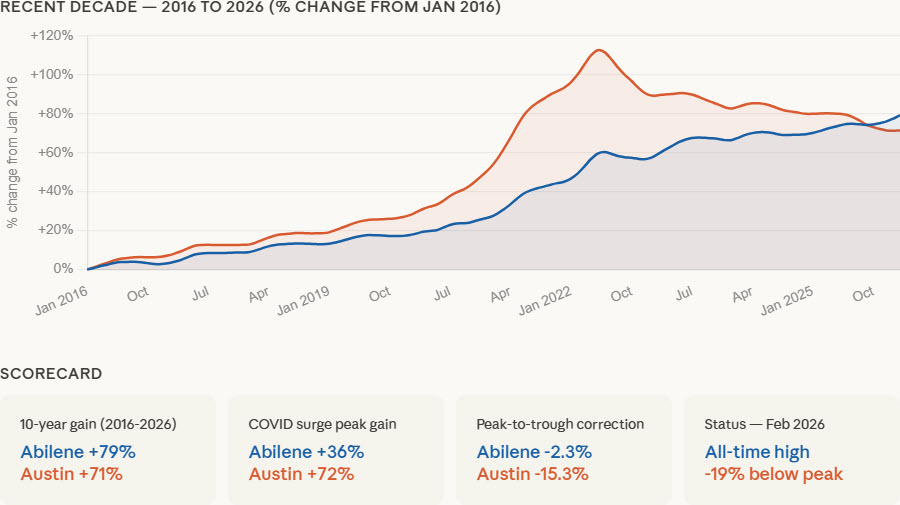
The Ten-Year Scorecard: Abilene +79%, Austin +71%
According to the Freddie Mac Home Price Index, which tracks all monthly observations for both the Abilene MSA and the Austin-Round Rock MSA without seasonal adjustment, Abilene home values increased 79% from January 2016 through February 2026. Austin came in at 71% over the same period. That eight-percentage-point gap is not noise — it reflects two fundamentally different market structures playing out over a full real estate cycle.
For most of the decade, the two markets moved in lockstep. From 2016 through late 2019, both cities logged modest, steady appreciation consistent with a healthy but unspectacular Texas real estate environment. Then the pandemic changed everything — but it changed things very differently for each city.
Market Performance Scorecard (2016–2026)
Austin's COVID Surge: The Biggest Run-Up in the State
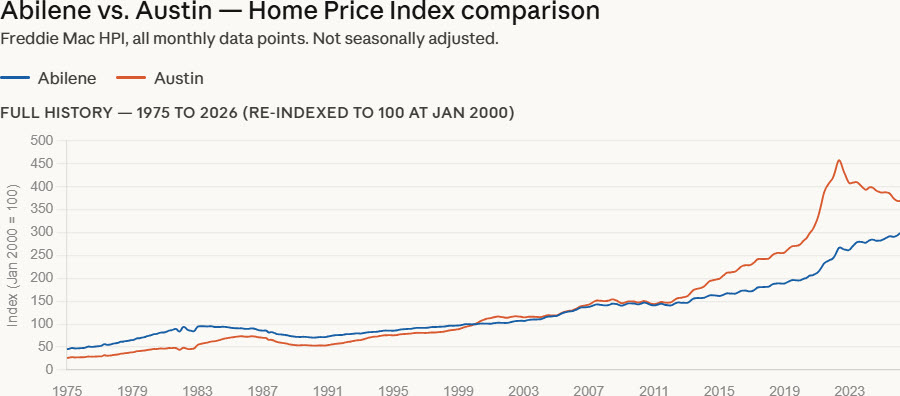
Between early 2020 and June 2022, Austin home prices surged 72% — one of the most dramatic appreciation events ever recorded in a major Texas metro. The city became a magnet for remote workers fleeing California and the Northeast, tech company relocations, and speculative investment from buyers who believed Austin had permanently repriced to a new, higher baseline. At its peak, the Austin-Round Rock MSA's Freddie Mac HPI index eclipsed 450 (re-indexed to 100 at January 2000), a level no one had modeled or anticipated.
Abilene, by contrast, posted a COVID surge gain of just 36% over the same period — less than half of Austin's run-up. There was no speculative frenzy, no tech migration, no national media coverage of bidding wars. The West Texas market simply appreciated at a pace consistent with its underlying economic fundamentals.
Austin's COVID Surge: The Biggest Run-Up in the State
Between early 2020 and June 2022, Austin home prices surged 72% — one of the most dramatic appreciation events ever recorded in a major Texas metro. The city became a magnet for remote workers fleeing California and the Northeast, tech company relocations, and speculative investment from buyers who believed Austin had permanently repriced to a new, higher baseline. At its peak, the Austin-Round Rock MSA's Freddie Mac HPI index eclipsed 450 (re-indexed to 100 at January 2000), a level no one had modeled or anticipated.
Abilene, by contrast, posted a COVID surge gain of just 36% over the same period — less than half of Austin's run-up. There was no speculative frenzy, no tech migration, no national media coverage of bidding wars. The West Texas market simply appreciated at a pace consistent with its underlying economic fundamentals.
The Correction: Austin Gave Back 15%, Abilene Gave Back Almost Nothing
When the Federal Reserve began its aggressive rate-hiking cycle in 2022, Austin faced a reckoning that no amount of long-term optimism could fully cushion. Demand collapsed faster than supply could adjust, and the market gave back 15.3% from its June 2022 peak through the trough. That correction erased years of appreciation for buyers who purchased at or near the top of the market.
Abilene barely moved. The peak-to-trough correction in Abilene came in at just 2.3% — effectively statistical noise for a real estate market. Owners who bought any time during the COVID run-up retained virtually all of their gains. There were no underwater appreciation positions, no sellers forced to price below their entry point, and no wave of demoralized buyers watching their equity evaporate.
This divergence illustrates a fundamental principle in real estate market analysis: markets that experience the sharpest appreciation spikes are almost always the most vulnerable to severe corrections. Austin's 72% run-up created the conditions for its 15.3% pullback. Abilene's restrained 36% gain left almost no air in the market to let out.
Where Each Market Stands as of February 2026
As of February 2026, the status of the two markets could not be more different. Abilene is at an all-time high on the Freddie Mac HPI. Every homeowner in that MSA, regardless of when they bought during the last decade, is sitting on positive appreciation with no correction exposure. The market never gave them a reason to question their purchase.
Austin is a different story. The Austin-Round Rock MSA remains approximately 19% below its June 2022 peak as of February 2026. That means buyers who purchased at the top of the market are still underwater on appreciation, even four years later. The long-term trajectory for Austin remains positive — the city's economic fundamentals, population growth, and employment base are among the strongest in the country — but the path back to peak pricing requires continued, sustained recovery.
Looking at the full historical picture from 1975 through 2026, Austin and Abilene tracked each other closely for most of the modern era. Both markets traded in similar index ranges from the late 1970s through the 2010s. The COVID era is when their paths violently diverged, and the post-correction period is where Austin's long-term strength and Abilene's short-term stability tell very different stories depending on what metric you prioritize.
What This Means for Austin Buyers and Sellers in 2026
For buyers in the Austin real estate market, the February 2026 data presents a nuanced picture. The fact that Austin remains 19% below its 2022 peak could be interpreted as a buying opportunity — values are meaningfully lower than they were at the height of the Austin housing trends cycle, and the underlying demand drivers that fueled the original surge have not disappeared. Austin's job market, population inflows, and quality of life continue to attract residents and employers.
For sellers, patience remains the operative strategy. The Austin housing market update through early 2026 shows a market still working through its post-correction phase. Sellers who bought before 2021 are generally in a strong equity position and have flexibility on pricing. Those who purchased at or near the 2022 peak may need to calibrate their expectations to current market conditions rather than peak-era comps.
The comparison with Abilene is instructive not because Austin buyers should consider relocating to West Texas, but because it highlights how much of Austin's long-term appreciation story is tied to volatility management. Markets that avoid extreme swings generate more durable wealth for their residents over time. As Austin works through its recovery, the austin real estate market continues to be one of the most closely watched in the country — and for good reason.
Frequently Asked Questions
Why did Austin home prices drop so much after 2022?
Austin home prices fell approximately 15.3% from their June 2022 peak because the market experienced one of the sharpest speculative appreciation cycles in U.S. history during the pandemic. When the Federal Reserve raised interest rates aggressively starting in 2022, buyer demand collapsed rapidly while the market was still flooded with inventory from the construction boom that followed the surge. The Austin housing market had priced in continued exponential demand that did not materialize once mortgage rates doubled, leaving values significantly overextended relative to income and rent fundamentals. The correction is a direct mathematical consequence of the 72% run-up that preceded it.
Is Austin a good real estate investment in 2026?
Austin remains one of the strongest long-term real estate markets in the United States based on its employment base, population growth trajectory, and infrastructure investment. However, buyers in 2026 should understand that the market is still approximately 19% below its all-time peak, which means the short-term appreciation environment is more muted than during the 2020–2022 cycle. The Austin real estate market offers value relative to peak pricing, but it is not a market where rapid appreciation should be the primary investment thesis in the near term. Long-term holders with a five-to-ten year horizon are better positioned than those seeking short-term flips.
How does the Freddie Mac Home Price Index work?
The Freddie Mac Home Price Index (HPI) is a repeat-transaction index that measures price changes for single-family properties using data from mortgage purchases and refinances. Because it tracks the same properties over time, it provides a more accurate measure of pure price appreciation than median sale price, which can be distorted by changes in the mix of properties sold. The index is re-indexed to 100 at January 2000, so a reading of 380 means home values have increased 280% since that baseline. The Freddie Mac HPI is not seasonally adjusted in the version referenced in this analysis, meaning short-term monthly fluctuations may reflect seasonal patterns in addition to underlying price trends.
Will Austin home prices recover to their 2022 peak?
Most Austin real estate market forecasts suggest a return to peak pricing is a matter of when, not if, given the city's long-term demand fundamentals. However, the timeline is uncertain and depends heavily on the trajectory of mortgage rates, job growth in the technology sector, and the pace of new construction absorption. At the current rate of recovery, Austin is tracking toward a multi-year path back to its June 2022 highs. Buyers who purchase in the current environment will likely benefit from the recovery, but should not expect peak pricing to return in the immediate near term.
What is the difference between a metro MSA home price index and median home price data?
A Metropolitan Statistical Area (MSA) home price index like the Freddie Mac HPI measures price changes across all properties in a defined geographic area using repeat-transaction methodology, making it the most reliable indicator of true appreciation and depreciation. Median home price data, which is commonly reported by MLS organizations and news outlets, reflects the midpoint sale price of all transactions in a given period and can be heavily influenced by changes in what types of homes are selling — more luxury sales push the median up, more entry-level sales push it down, independent of whether any individual home has actually changed in value. For tracking actual price appreciation in the Austin housing market, the HPI is the more analytically rigorous metric.